Introduction
Polymarket is a fast-growing platform where people can bet on pretty much anything and everything, from when the United States will strike Iran, to how many tweets will Elon Musk post tomorrow.
In this report, we visualize the “entire Polymarket landscape” using network analysis techniques. We dive into different betting events to understand what people are betting on. We find that election events are at the center of Polymarket. We also find niche markets focusing on crypto, sports and Elon Musk's tweets. Polymarket is in a unique position to connect Web 2.0 (social media activity) with Web 3.0 (blockchain activity). Read on to find out more!
How to visualize Polymarket
Our goal is to connect all active users with all events they betted on. To achieve this, we first collect all active events from Polymarket API on January 25, 2026. An example event is: “Will New England beat Seattle in Super Bowl LX?”
For each event, we extract all markets. Markets are particular conditions, like “yes” or “no”, which users can bet on. For each market, we extract the top 20 users (ranked by the amount of money they have betted on this market).
We then build a social network, where nodes are users and events. A user node is connected to an event node if that user is among the top 20 holders under that event. We filter out transactions fewer than 1000 USD. The filtering step reduces the computation cost, but still preserves the network structure.
We use graph clustering algorithms to find clusters of similar events. We use AI to summarize long texts and generate analysis code. This report is written by a human.
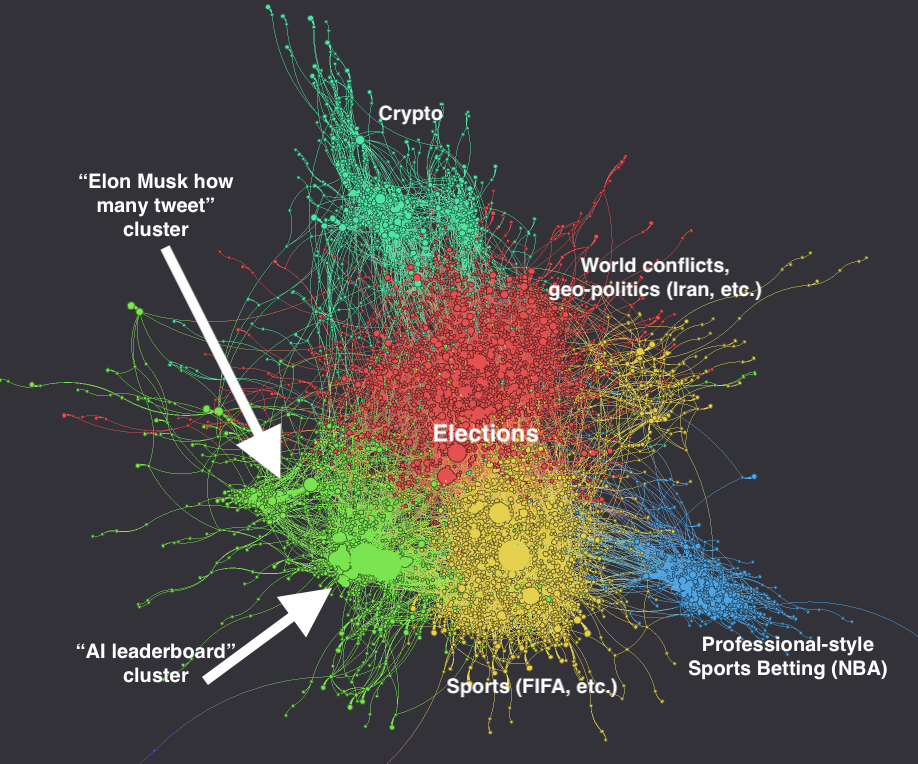 User–event network of active Polymarket events (January 25, 2026). Nodes represent users or events; edges connect top holders to events.
Key insights
-
“Elon Musk how many tweet” cluster
A small green cluster on the left of the network focuses on questions like:
- “Will Elon Musk post 120-139 tweets in March 2026?”
- “Will Elon Musk post 160-179 tweets in March 2026?”
- “Will Elon Musk post 220-239 tweets in March 2026?”
Why do people bet on those events? One reason is that Elon Musk’s posts are highly influential. Back in 2025, we worked with the University of Copenhagen on the Smidge Project (link). As part of the investigation, we collected all posts from
@ElonMuskfrom May 31, 2024 to January 2, 2025 (217 days).Elon Musk tweeted actively during this time period, especially around the 2024 US election. On average, Elon Musk posts 81.2 times (not counting native retweets) per day, with each post receiving 9.5 million views.
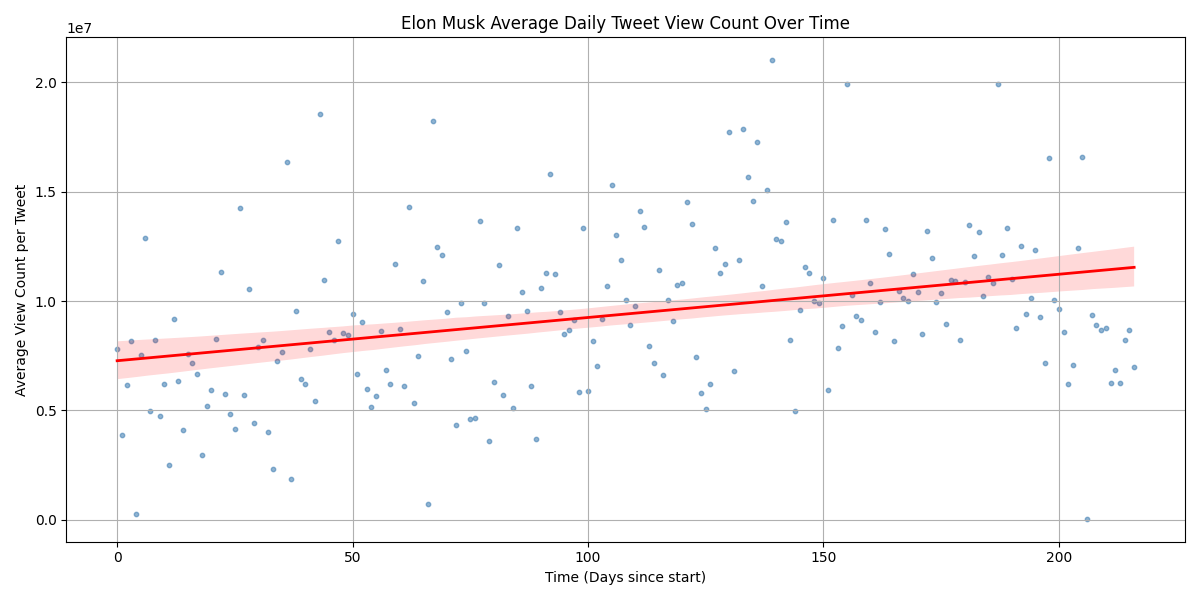 Views per
 @ElonMustpost during May 31, 2024 – Jan 2, 2025.The total view count of his posts across those 217 days is 168 billion. That’s roughly equivalent to every human on earth reading at least two posts from
@Elonmusk.In addition, we find that the average view count per
@Elonmusktweet increases over time (from ~7 million in May 2024 to ~11 million in January 2025). One year later, Polymarket is further growing the account’s influence. -
“Magic vs. Cavaliers: 1H O/U 115.5”
Sports betting is popular on Polymarket. We observe a large yellow cluster of sports events. We also find a smaller blue cluster (on the bottom right of the network) with more niche sports events. One event is: “Magic vs. Cavaliers: 1H O/U 115.5”.
What does the event mean? What are people betting on?
Turns out this is a first-half total points bet. Here’s the breakdown:
- Magic vs. Cavaliers: The game between the Orlando Magic and the Cleveland Cavaliers (an NBA game).
- 1H = First half only. Only points scored in quarters 1 and 2 count. The second half is irrelevant.
- O/U 115.5 = Over / Under 115.5 total points. People are betting on whether the combined score of both teams at halftime is:
- Over 115.5 → 116 points or more
- Under 115.5 → 115 points or fewer
The possibilities and combinations seem limitless. As Polymarket grows, we expect to see more “market-maker menu” events.
-
Crypto versus sports
Other than sports, crypto is another hot sector. Sports and crypto feel “close”. In recent years, sports and crypto logos often appear together on TV—crypto companies partner with the NBA and sponsor football leagues (link).
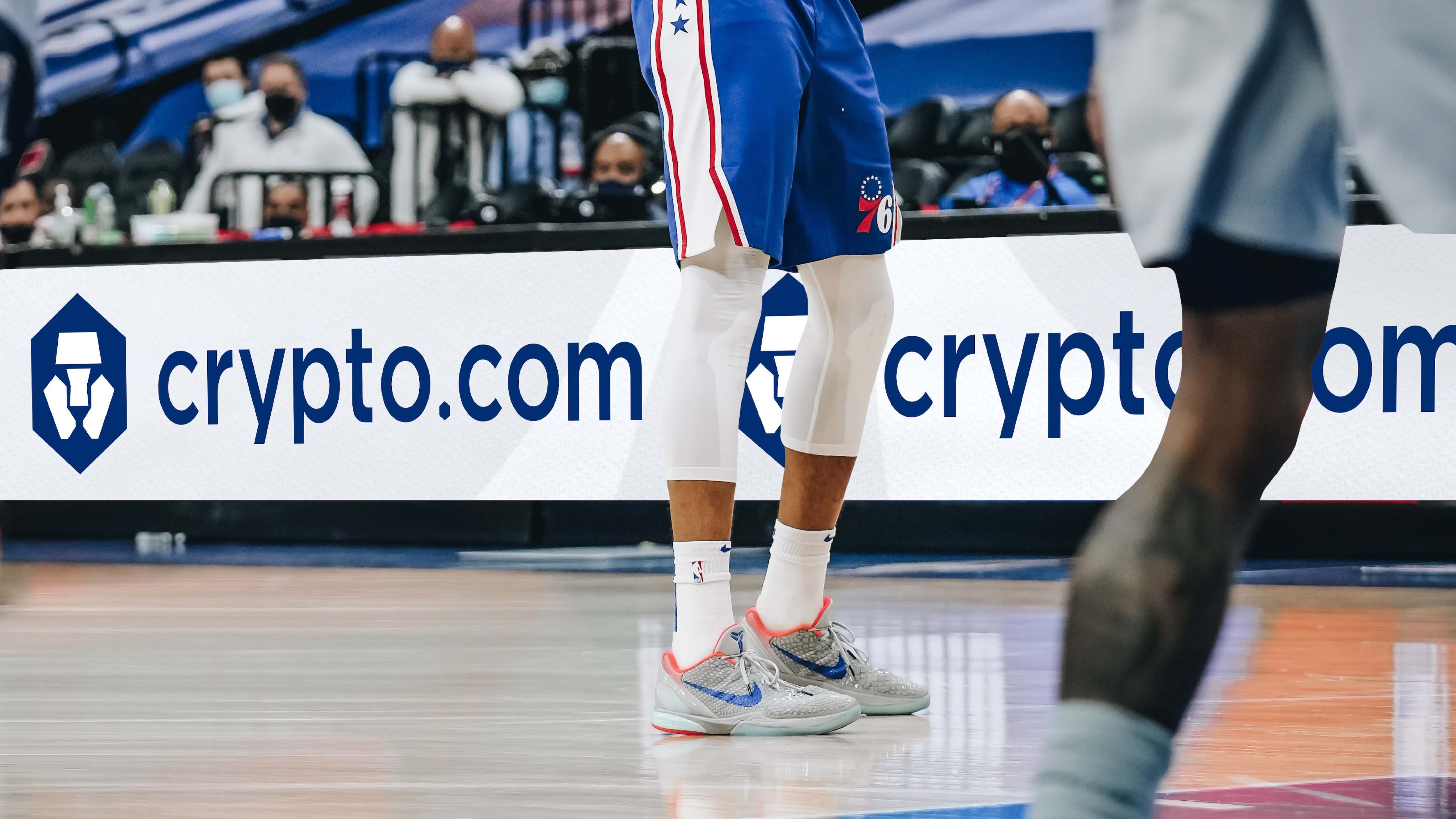 Crypto and sports branding often appear together—but their betting communities don’t necessarily overlap.
However, based on our network analysis, the crypto cluster (aquamarine color on the top) is far from the sports cluster (yellow color on the bottom).
Why are people who bet on crypto actually far away from people who bet on sports (in other words, those two groups of users are different)?
From a trader’s point of view, crypto and sports are very different: sport (excluding online games) is physical and crypto is virtual. To bet on a sport, one has to watch players play. To bet on a cryptocurrency, one has to follow news on X or Telegram. With 24 hours in a day, there is only so much one can focus on.
-
Election and politics – the core of Polymarket
Our network analysis shows that the largest cluster, and the one with the most trading activity, is related to elections and politics.
In fact, from 2022 to the end of 2025, the peak trading day on Polymarket is November 04, 2024, the day before the 2024 US Election.
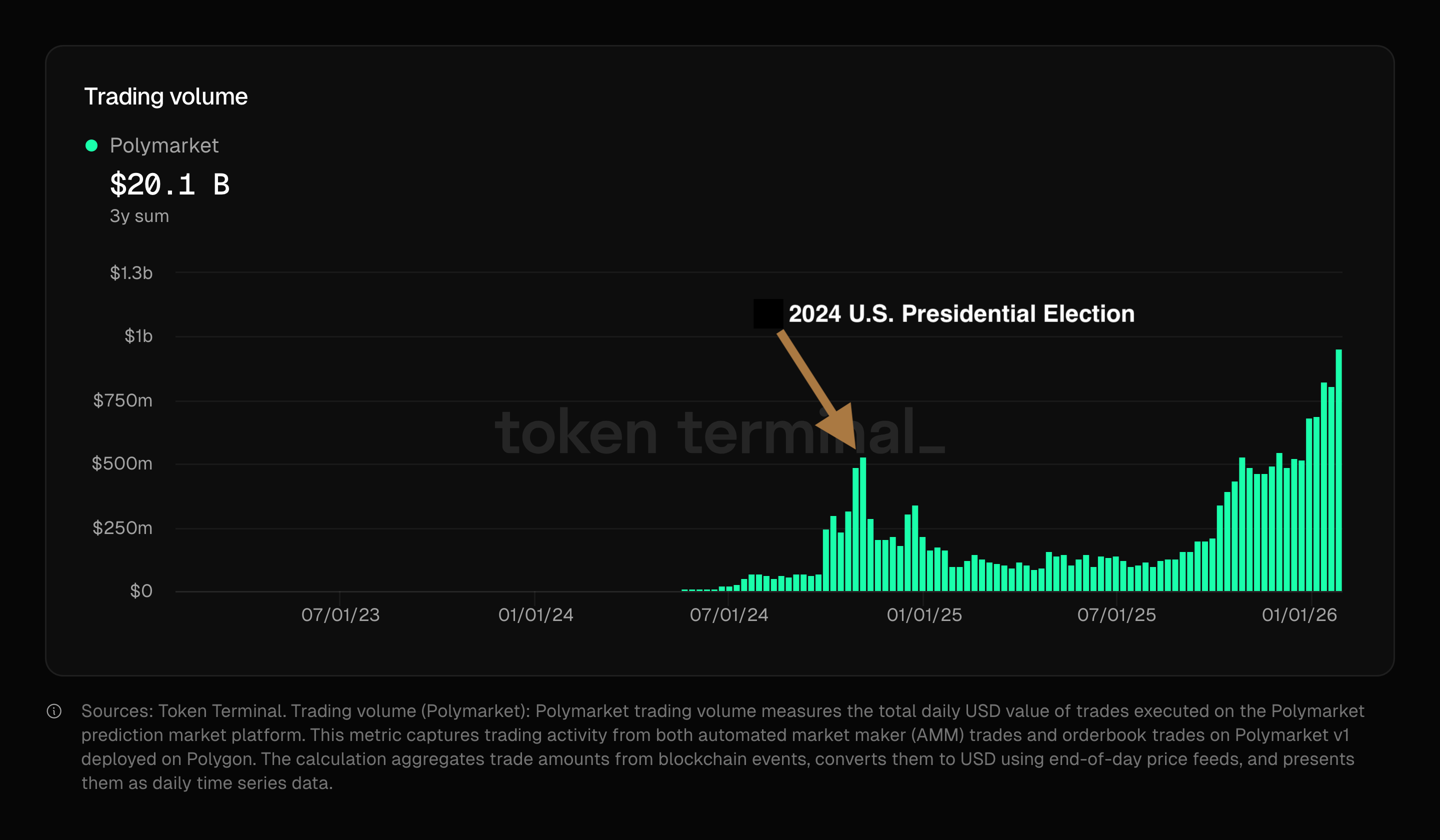 Polymarket trading volume peaks around major political events (notably Nov 4, 2024).
What does this tell us about Polymarket, or people betting on the platform? When we bet on political events, are we just speculating?
Maybe—if you are not inside the political circle. As Representative Ritchie Torres of New York (link) said: “When you’re a government insider, the term prediction market is a misnomer, because if you’re the one making the decision, or if you’re part of the decision-making process, you’re not predicting anything. You’re governing for profit.”
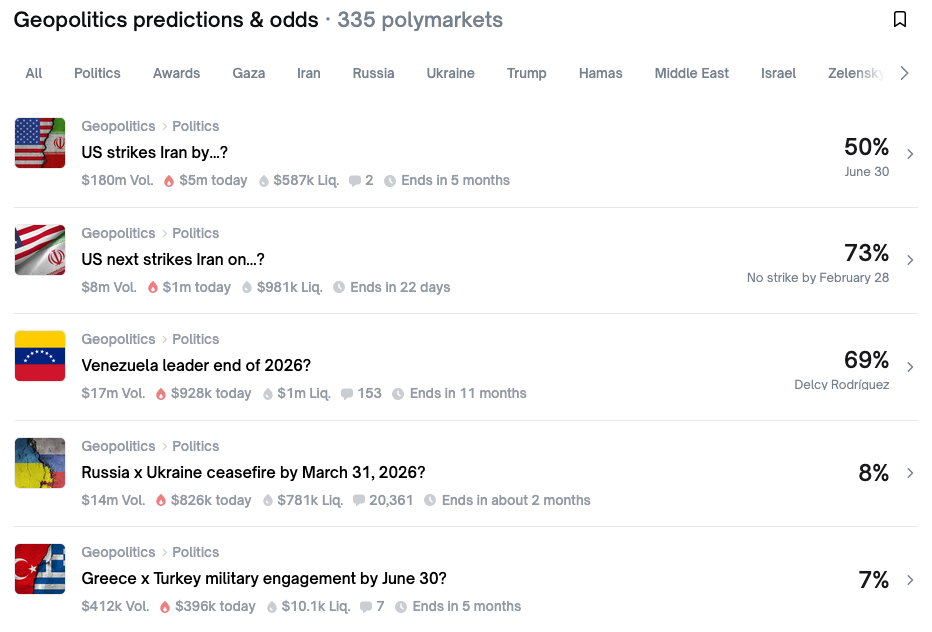 if you know you know...
Next steps: Polymarket is highly dynamic. We plan to keep monitoring the Polymarket landscape. We will automate network analysis to extract signals in near real-time (like which cluster is growing). The intelligence will be valuble for traders, journalists, policy watchers and more.
We want to hear from you: If you have any ideas, or want to conduct similar analysis for your own organization using our technology, please email us at zhouhan@safelink.network
Acknowledgement: We thank Pili Hu for the generous feedback.